Article

Opaque DOIs: what they are and why we recommend them

Since OJS 3.4, the system generates DOIs with a random suffix, with no initials, volume or issue. It is what Crossref recommends, and what OJSBR recommends for every new registration.

By Eder Sotto · OJSBR · Published on

Crossrefhttps://doi.org/10.52079/f9e2y-bbb51

Every DOI has two parts: the prefix, which identifies the organization that registered the content, and the suffix, which identifies each item. For many years, journals built the suffix from information about the publication itself, such as its initials, volume, issue and article number. Since OJS 3.4, the system default has changed: the suffix is now opaque, a short random string that says nothing about the publication. In this article I explain what that means, why Crossref recommends this format and why OJSBR recommends it too.

What an opaque DOI is

An opaque DOI is one whose suffix carries no meaning. Compare the two formats:

  • Meaningful suffix: 10.xxxx/rbca.v14i2.883. You can read the journal initials, volume 14, issue 2 and article number 883. This was the OJS default up to version 3.3.
  • Opaque suffix: 10.xxxx/n96gt730. Eight characters with no information about the publication. This is the OJS default from version 3.4 onwards.
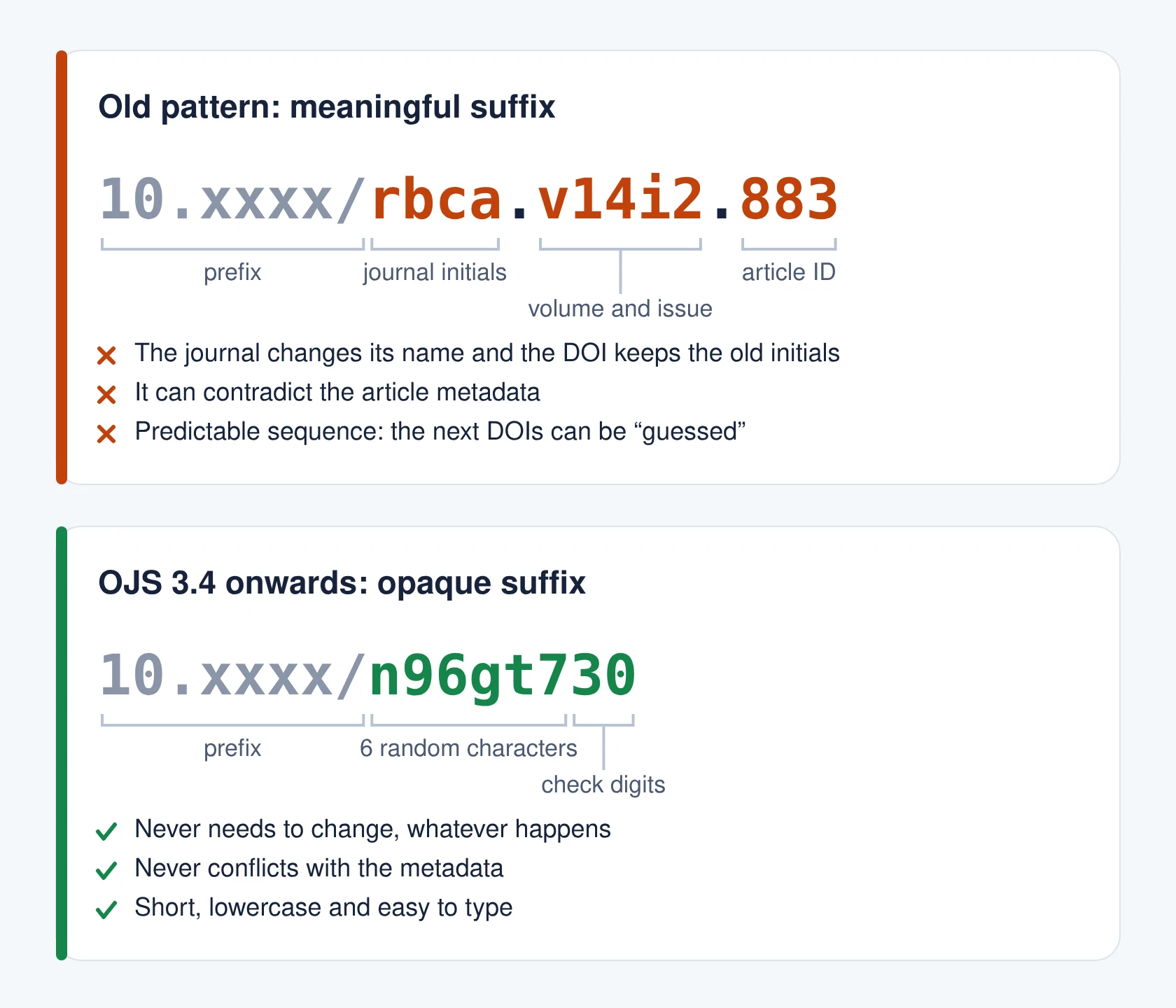
Comparison between a DOI with a meaningful suffix (journal initials, volume and issue, article ID) and a DOI with an opaque suffix (six random characters and two check digits)
The same article in both formats. The examples use the generic prefix 10.xxxx.

The information that used to go into the suffix is not lost: title, journal, volume, issue, pages and date are still registered with Crossref, in the DOI's metadata. That is where databases, indexes and reference managers look for this information, not in the text of the identifier.

Why Crossref recommends it

Crossref's guidance for anyone building DOIs is straightforward: use a random suffix, so that the DOI is “opaque or ‘dumb’”, and keep it short. The reasons are on the Constructing your DOIs page:

  • Information changes, the DOI does not. A journal may change its name or initials, and an article may move to another issue before it comes out. Once registered, a DOI is permanent, and it would carry the old information forever.
  • Suffix and metadata can contradict each other. When the suffix says one thing and the metadata says another, readers cannot tell which to trust.
  • Sequences are predictable. A numeric pattern lets anyone work out future DOIs before they exist, which leads to broken links and attempts to reach content that has not been published yet.
  • Short is better. A short suffix is easier to read, copy and type.

One example of good practice that Crossref itself cites is https://doi.org/10.3390/s18020479. The OJSBR blog follows the same model: its articles have opaque DOIs registered under our prefix, such as https://doi.org/10.52079/hmhcf-74961.

The OJS default since version 3.4

In OJS 3.4, DOI management became part of the core system, and the default suffix became opaque. Under Settings › Distribution › DOIs, the DOI format section offers three options:
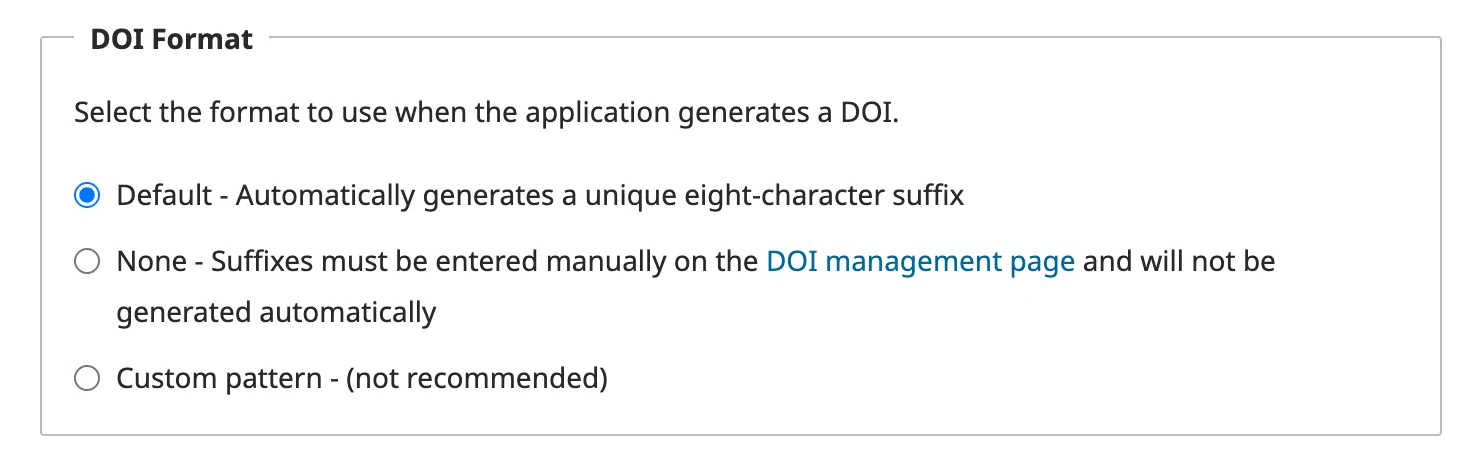
DOI format settings in OJS 3.5, with the options Default, None and Custom pattern (not recommended)
DOI format settings in OJS 3.5. The system itself labels the custom pattern “not recommended”.
  • Default: automatically generates a unique eight-character suffix. This is the opaque option, and the one we recommend.
  • None: the suffix is typed by hand for each item, on the DOI management page.
  • Custom pattern: builds the suffix from initials, volume, issue and other data, as in OJS 3.3. OJS itself describes it as “not recommended”.

The suffix generated by OJS has six random characters and two check digits, always in lowercase. The characters follow Crockford's Base32 alphabet, which leaves out the letters i, l, o and u precisely so they are not confused with 1 and 0. The two final digits are calculated from the first six and make it possible to check that the DOI was copied correctly.

Journals that upgraded from OJS 3.3: those using the old default start generating opaque DOIs automatically after the upgrade. DOIs already assigned stay exactly the same, and the old pattern is saved as a custom pattern in case the journal prefers to keep it.

Advantages in practice

  • Permanence without surprises. A change of name, initials or publication frequency does not leave the DOI out of date.
  • A DOI before the issue exists. OJS can create the DOI as early as the copyediting stage. With the old pattern, if the article is not yet scheduled in an issue, the volume and issue come out empty in the suffix. With an opaque suffix, that never happens.
  • Ready for continuous publication. Journals that publish articles as soon as they are ready, without waiting for the issue to close, do not depend on volume and issue to generate the DOI.
  • One format for everything. Articles, issues and galleys in OJS, and books and chapters in OMP, use the same format, with no separate pattern for each type.
  • Fewer typing errors. Eight characters, no ambiguous letters and built-in check digits.
  • Consistency with the metadata. What identifies the article lives in the metadata registered with Crossref, in one place.

What about existing DOIs?

They remain valid, unchanged. The recommendation to use opaque suffixes applies to new registrations. Crossref is clear: there is never a need to delete or update existing DOIs, and a registered DOI should always keep pointing to the same content. A journal can have older DOIs with initials and volume alongside new opaque ones, and that is perfectly normal.

Do not create a new DOI for content that already has one. The format can only be changed while the DOI has not yet been registered with Crossref. Once registered, it is permanent.

OJSBR's recommendation

  • An opaque suffix for every new registration. This applies to journals, books and proceedings, on OJS, OMP or custom websites.
  • Registered DOIs stay as they are. We never replace or duplicate DOIs.
  • The journal decides. If the editorial team prefers to keep the old pattern, we set up the custom pattern and explain what changes.

For the new journals we set up, OJS comes configured with the default suffix. If your journal has upgraded and its DOIs changed format, or you want to understand which option makes more sense for your publication, talk to us.

Need help with OJS, OMP or DOI?

Managed hosting, specialized support and DOI registration with no annual fee.

Request a quote
Read next